


Insights that advance infection prevention.
One Formula, Four Formats: Inside the CHG Skin Antiseptic Applicator Range
Skin antisepsis is usually described as a single step, yet the surface it has to cover changes with every procedure: a two-inch field before a venipuncture, a wide pre-operative area around a surgical site, a moist fold that behaves nothing like intact dry skin. The CHG applicator range from Huachenyang is built around that reality — one 2% chlorhexidine gluconate and 70% isopropyl alcohol formula, delivered through four activation formats, in volumes from 1.5 mL to 26 mL.
The constant: a formula designed for residual action
CHG works by disrupting the microbial cell membrane and precipitating its contents, while isopropyl alcohol denatures cell proteins on contact. The combination gives rapid bactericidal action across a broad spectrum — including MRSA, VRE, CRE, Clostridium difficile, Acinetobacter, most viruses and fungi — and then keeps working, with antimicrobial activity maintained for more than 48 hours.
Fast kill and long tail are two different claims. A prep product has to deliver both, because the interval between prep and puncture is where control is usually lost.
Four formats, one technique
- Press-down applicator. Pull and remove the ring collar lock, then press down to release solution into the foam pad — no twisting, and the pad is never touched by hand.
- Screw-down applicator. Peel the pouch, remove the middle ring collar, and screw the upper handle clockwise until it closes firmly against the lower handle.
- Snap-type applicator. Snap the handle to break the internal film so the solution saturates the pad; the application steps are then identical to the other formats.
- Impregnated swab stick. Tear the pouch at the notch, twist the swab free, and place the foam flat side down on the treatment site for small-field work.
Choosing volume by coverage area
The range is specified by the skin area each unit can reliably wet, not by volume alone. Approximate coverage runs from about 2 x 2 inches for a 3 mL swab stick, to roughly 4 x 4 inches for the 3 mL and 6 mL applicators, and beyond 8 x 8 inches for the 26 mL press-down unit used on large procedural fields. The 10.5 mL format sits just under 8 x 8 inches. Handles are supplied in green or white, heads in round or rectangular profiles, and the solution is available clear or tinted purple, orange or green where a visual indicator is preferred.
Contact time is not optional
On dry sites the guidance is gentle back-and-forth strokes at the insertion or incision site for 30 seconds before moving to the periphery, then allowing the area to air dry completely for about three minutes — and up to an hour where hair is present. Moist sites such as the inguinal fold or axilla are prepped for two minutes and given the same three minutes to dry. The solution should not be blotted or wiped away, and drapes, dressings or laser procedures should wait until the skin is fully dry.
Where it should not be used
- Patients with a known allergy to chlorhexidine gluconate or isopropyl alcohol.
- Children under two months of age, where skin irritation is a risk.
- Lumbar puncture, or any procedure in contact with the meninges.
- Open skin wounds, or as a general skin cleanser.
Contact with eyes, ears and mouth must be avoided; if it occurs, rinse with cold water immediately and seek medical advice. Use should stop if irritation, sensitisation or an allergic reaction appears.
Made where the documentation is
Units are assembled under Class 100,000 cleanroom conditions with a two-year shelf life as standard, packed 1,000 per case for applicators, 50 per case for the 26 mL format and 5,000 per case for swab sticks. The manufacturer has held CE certification since 2013, FDA approval since 2014 and a GMP-based Free Sale certificate since 2018, with more than 20 patents across its portfolio. Handles are latex and DEHP free, and the long plastic body is designed to keep the clinician's hand away from the patient's skin throughout the stroke.
The practical argument for sourcing every format from one supplier is not price. It is that a protocol written once can be followed at every site, with the same contact time, the same documentation and the same residue profile.
More Articles
View All News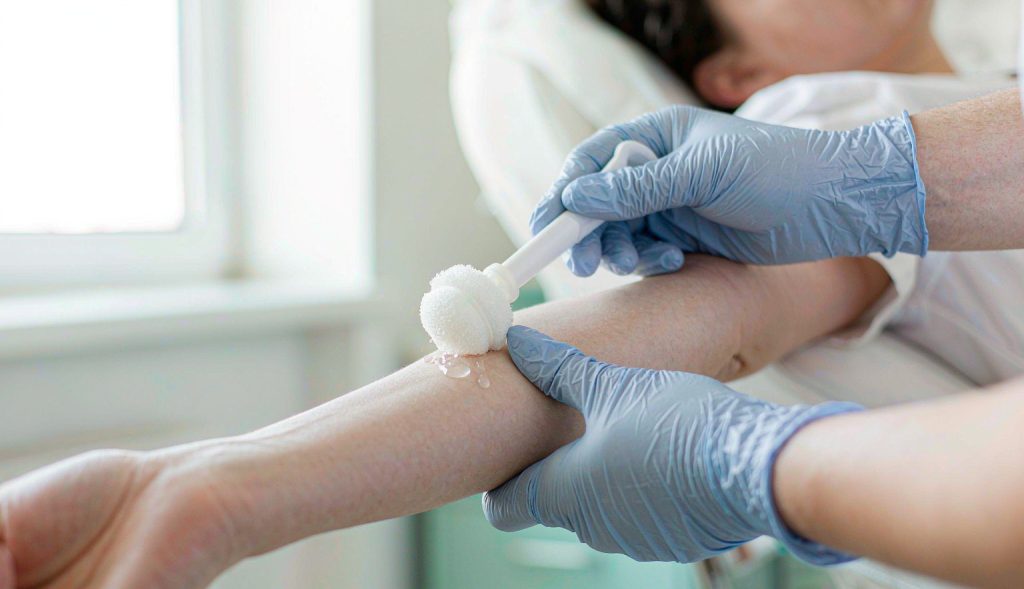
One Formula, Four Formats: Inside the CHG Skin Antiseptic Applicator Range
Press-down, screw-down, snap-type and impregnated swab sticks: one 2% CHG and 70% IPA formula, four…

Audit-Ready Infection Prevention: Digital Tracking Meets CHG Protocols
Combine digital tracking with CHG skin-prep protocols to build audit-ready infection prevention reco…

Single-Use CHG Applicators Cut Skin-Prep Time in Emergency Departments
Single-use CHG applicators shorten skin-prep time in emergency departments while improving applicati…

New Lab Study Reinforces CHG Efficacy for Skin Antisepsis
A new laboratory study reinforces the antimicrobial efficacy of chlorhexidine gluconate skin antisep…

Standardizing Skin Prep for Injections, IV Lines and Vaccinations
How standardized CHG skin preparation protocols improve injection safety, IV line care and vaccinati…
Ready to Elevate Your Infection Prevention Standards?
Contact our team for product samples, pricing, and regulatory documentation. We support OEM/ODM and global distribution partnerships.